Sudoku is not magic brain training – what, then, makes people love it?
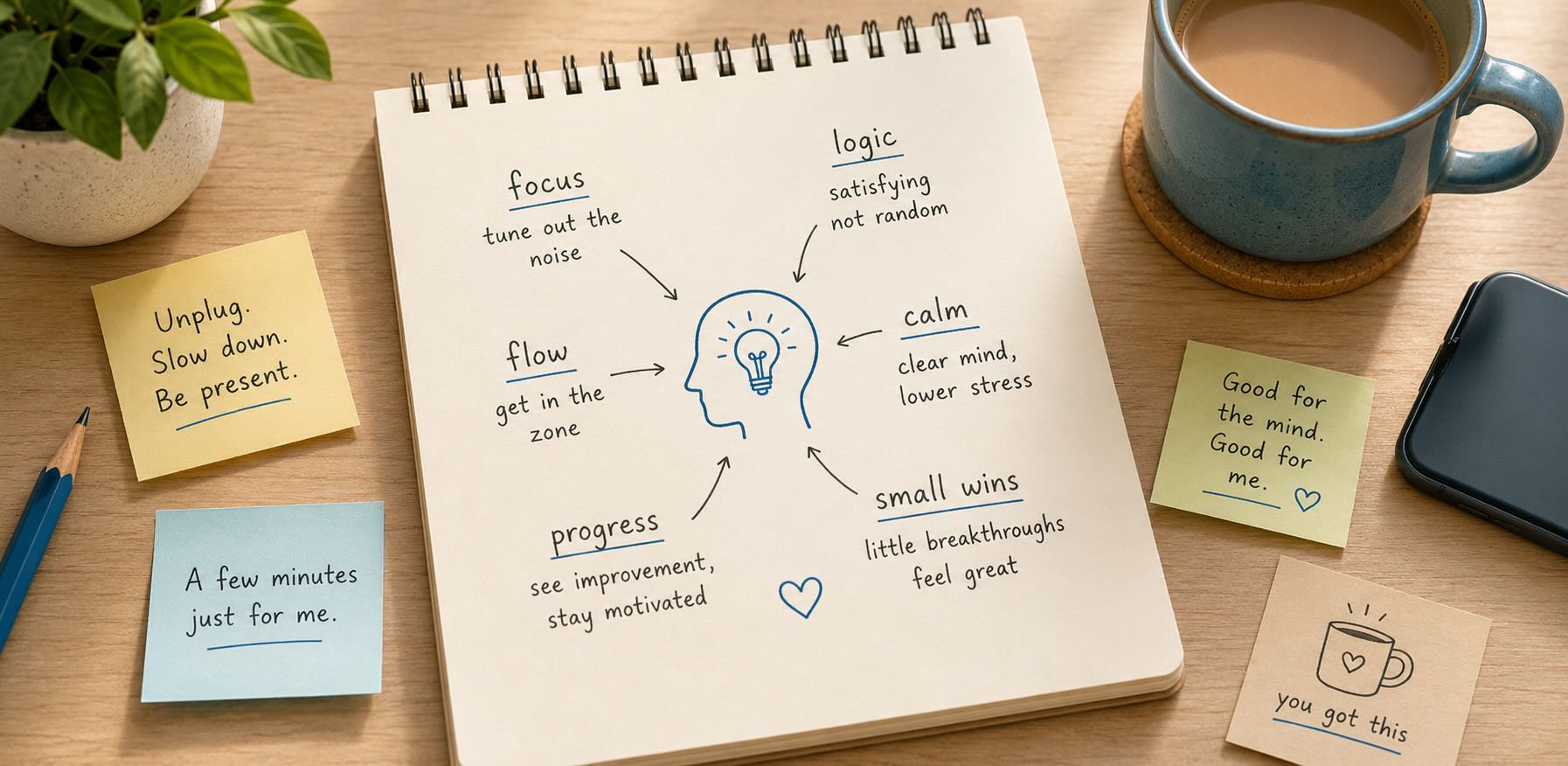
Sudoku is often described as a kind of brain exercise, but that does not fully explain why so many people enjoy it. To understand the appeal, it helps to look past health claims and focus on the experience of solving the puzzle.
Sudoku is often described as “good for your brain.” That may be true in a simple everyday sense: Sudoku makes you focus, remember possibilities, recognise patterns, and reason logically.
But it is easy to take that idea too far.
Sudoku is not a magic shortcut to better brain health. It should not be treated as a proven way to prevent dementia, increase intelligence, or improve every part of your thinking. Scientific studies can show that Sudoku is mentally engaging, and that solving puzzles uses skills such as attention and working memory. That is different from proving that Sudoku creates broad, lasting health benefits for everyone who plays it.
So if Sudoku is not a miracle brain exercise, why is it with Sudoku that makes so many people love it?
The answer is probably simpler, and more interesting: Sudoku feels good to solve.
It offers focus, structure, progress, and the quiet satisfaction of finding an answer for a reason.
Sudoku does not need to be a health cure
One of the best things about Sudoku is that it does not need to promise too much.
A puzzle can be worthwhile even if it is not medicine. A game can be meaningful even if it does not transform your brain.
Sudoku gives you a clear task. The rules are simple. The goal is easy to understand. Every row, column, and 3×3 box must contain the numbers 1 to 9. Nothing more complicated than that is required to begin.
At the same time, solving a good Sudoku puzzle is not random. You have to look, compare, eliminate, and reason. Each number you place should have a logical reason behind it.
That combination is powerful: simple rules, but deep solving.
The real appeal is logical satisfaction
The pleasure of Sudoku is not just finishing the puzzle. It is the feeling that each answer was earned.
When you solve a cell, it is not because you guessed well. It is because the puzzle gave you enough information, and you found the logic hidden inside it.
A number may not be obvious at first. Then you notice that it cannot go in this row, cannot go in that box, and cannot fit anywhere else in the column. Suddenly, the answer is not just possible. It is forced.
That moment is satisfying. It feels like the puzzle has clicked into place.
This is one reason Sudoku remains popular. It gives you many small “aha” moments before the final solution. Each one makes the board a little clearer.
Sudoku creates a sense of order
A Sudoku puzzle starts with empty spaces. Some information is missing. The board is incomplete.
As you solve, the grid becomes more ordered. Uncertainty turns into structure. Empty cells become fixed numbers. Possibilities narrow until only one answer remains.
That process can feel calming and satisfying, even when the puzzle is challenging.
In everyday life, many problems are messy. Rules are unclear. Answers can be subjective. Progress can be hard to measure.
Sudoku is different. The rules are stable. The goal is clear. A correct number stays correct. A solved puzzle has a visible ending.
For many players, that sense of order is a big part of the appeal.
Simple rules make Sudoku easy to start
Sudoku does not require special knowledge.
You do not need vocabulary, trivia, advanced mathematics, or cultural background. The digits from 1 to 9 are used as symbols. The real challenge is not calculation, but placement.
That makes Sudoku easy to begin. A new player can understand the basic rule in a minute: each row, column, and 3×3 box needs the numbers 1 to 9.
But understanding the rule is not the same as mastering the puzzle.
As puzzles get harder, you need better scanning, cleaner notes, and more careful candidate elimination. Many advanced Sudoku techniques work by eliminating candidates that are not immediately ruled out by basic row, column, and box scanning.
This gives Sudoku long-term depth. You can enjoy it casually, or you can keep improving.
Sudoku rewards patience
Sudoku is not usually solved by one big insight. It is solved through many small steps.
You scan a row. You check a box. You remove a candidate. You notice that a number has only one possible place. You solve one cell, and that opens another.
This makes Sudoku a good puzzle for patient thinking.
Rushing often leads to mistakes. Slowing down helps you see more. The puzzle rewards careful attention, not just speed.
That is part of what makes Sudoku feel fair. If you get stuck, the answer is not hidden behind a trick question. More often, there is a relationship on the board that you have not noticed yet.
Sudoku can feel calming because it narrows your focus
Sudoku can feel calming because it gives your attention one clear job. For many people, this contrast is part of the appeal.
A busy day at work or at home, also called life, can be full of notifications, unfinished tasks, quick decisions, and shifting priorities. Sudoku offers the opposite experience: one small problem, one clear rule system, and one next step to look for.
Sudoku may not necessarily be a universal treatment for stress or anxiety. But it is reasonable to say that many people experience Sudoku as a focused, quiet activity. The puzzle creates a small space where the next step matters, but nothing outside the grid does.
Sudoku may not be mindfulness in the strict sense, but it can offer a similar kind of focused pause.
Sudoku often fits the feeling of flow
That focused pause can sometimes turn into something more absorbing.
Many people enjoy activities that are challenging enough to be interesting, but not so difficult that they become frustrating. This is often connected to the idea of flow: a state where you become absorbed in what you are doing.
Sudoku can fit this feeling well.
The goal is clear. Feedback is immediate. Either a number fits logically, or it does not. The challenge can also be adjusted by choosing an easier or harder puzzle.
When the difficulty is right, Sudoku can pull you in. You are not thinking about the whole day. You are thinking about the next logical step.
That focused involvement is one reason people return to Sudoku again and again.
Getting better feels good
Even if Sudoku is not magic brain training, you can absolutely get better at Sudoku.
You can learn to scan the grid more efficiently. You can become more comfortable with notes. You can recognise patterns sooner. You can make fewer mistakes. You can move from easy puzzles to harder ones and understand why they are harder.
That improvement is rewarding in itself.
Not every benefit has to be medical. Sometimes it is enough to learn a skill and feel yourself improving.
Sudoku gives clear feedback. A puzzle that once felt confusing may later feel manageable. A technique that once seemed advanced may become natural.
That kind of progress is motivating.
Why getting stuck is part of the appeal
Getting stuck is not always a bad thing.
In Sudoku, being stuck often means that the obvious moves are gone and the puzzle is asking for a different kind of observation. Maybe a candidate can be eliminated. Maybe a number only fits in one place. Maybe a pattern is hidden in the notes.
The satisfying part is not avoiding every difficult moment. It is finding a way through.
That is why a good hint should not simply give away the answer. It should help you understand the next logical step.
In MarApp Sudoku, Surrender can be used when you are stuck to show the next logical step. Used carefully, that kind of help can turn frustration into learning.
Sudoku is popular because it is both small and deep
A Sudoku puzzle is small enough to fit on a screen, a page, or a short break in the day.
But inside that small grid, there is real depth.
You can solve casually for relaxation. You can play for speed. You can use notes and study techniques. You can work through harder puzzles slowly. You can enjoy the same rules at many different levels.
That flexibility helps explain why Sudoku has stayed popular.
It is simple enough to start, but not simple enough to outgrow quickly.
Final thoughts
Sudoku does not have to be a miracle brain exercise to be worth playing.
It is enough that it gives you focus, structure, and progress. It is enough that the rules are simple, the challenge is fair, and every solved number feels earned.
Sudoku is loved because it turns logic into a quiet, satisfying puzzle.
You start with uncertainty. You look carefully. You eliminate what cannot work. And little by little, the board makes sense.
That feeling does not need a health claim.
It is already a good reason to play.