Beginner Sudoku – mistakes to avoid
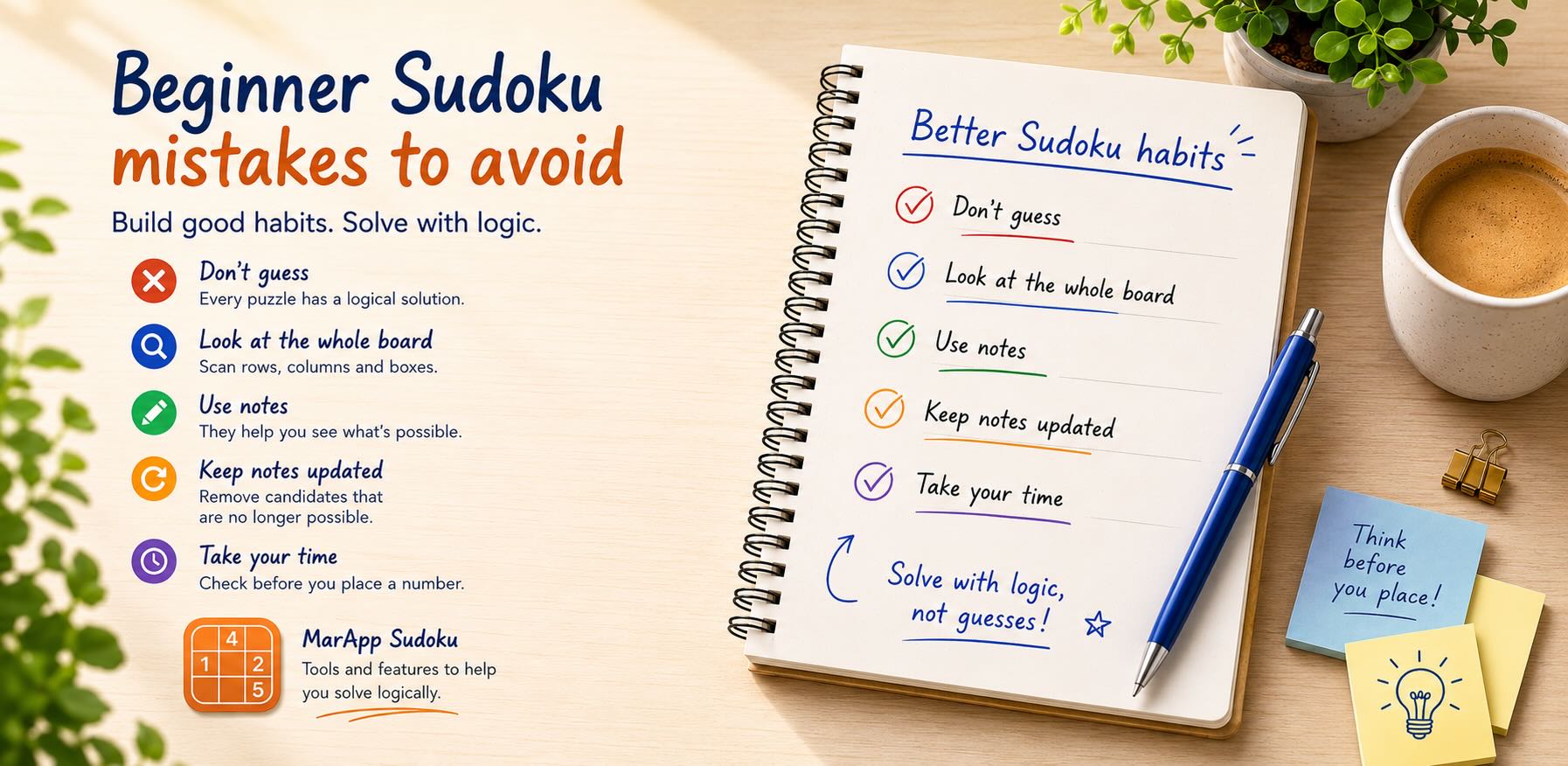
Sudoku is easy to start, but many beginners get stuck because they build a few bad habits early on. The good news is that most of these habits are easy to fix.
Sometimes the best Sudoku tips are not new techniques, but simple habits that help you avoid common mistakes.
A good Sudoku puzzle does not require guessing. If the puzzle is valid and has one solution, every step can be found with logic. The challenge is learning where to look.
Here are some common beginner mistakes — and what to do instead.
1. Guessing instead of looking for logic
Guessing can feel tempting when the board slows down. You might think, “This number probably goes here,” and hope the rest of the puzzle works out.
The problem is that one wrong guess can lead to many wrong numbers later. By the time you notice something is wrong, it may be difficult to find where the mistake started.
Instead, try to place a number only when you have a reason for it. Ask yourself:
- Why must this number go here?
If you cannot answer that question, it is probably better to wait and look somewhere else on the board.
In MarApp Sudoku, the Surrender feature can help when you are stuck. Instead of asking you to guess, it shows the next logical step so you can understand how the puzzle moves forward.
2. Looking only at one square at a time
A common beginner habit is to pick an empty square and try to work out what belongs there. Sometimes that works, but it can also make Sudoku feel random and frustrating.
Sudoku is often easier when you look at rows, columns and boxes together. Instead of asking only “What goes in this square?”, try asking:
- Where can this number go in this box?
- Where is this number missing in the row?
- Which numbers are already blocking this column?
This helps you see the board as a connected puzzle, not as 81 separate squares.
3. Forgetting the 3×3 boxes
Most new players remember to check rows and columns, but it is easy to forget that each 3×3 box also needs the numbers 1 to 9.
Before placing a number, always check three things:
- The row
- The column
- The 3×3 box
If the number already exists in any of those places, it cannot go there.
This simple habit prevents many early mistakes.
4. Not using notes
Notes, also called candidates, are small numbers that show what could still fit in a square. Many beginners avoid notes because they make the board look busier, but notes are one of the best ways to solve harder puzzles logically.
You do not need to add notes everywhere at once. Start simple. Add notes when you are unsure, or when a section of the board becomes difficult.
Good notes help you spot useful patterns, such as singles, pairs and locked candidates.
MarApp Sudoku includes note tools that make this easier to manage. You can add notes manually, and Premium players can also use auto-notes when they want help setting up candidates.
5. Letting notes become outdated
Notes are useful only when they stay accurate. If you place a number and forget to remove that number from nearby notes, the board can quickly become confusing.
After placing a number, check the same:
- Row
- Column
- 3×3 box
That number can no longer be a candidate in those areas.
Some Sudoku apps, like MarApp Sudoku, can help with this by removing candidates that are no longer possible as you play. That keeps the board cleaner, but it is still useful to understand why the notes change. The goal is not just to tidy the board — it is to learn the logic behind each move.
6. Missing easy singles
A “single” is one of the safest moves in Sudoku. It means either:
- A cell has only one possible number left
- Or a number has only one possible place in a row, column or box
Beginners often miss singles because they are looking for something more complicated. But many puzzles open up once you find just one simple move.
Look for:
- A cell with only one possible candidate
- A number that can go in only one place in a 3×3 box
- A row or column with only one missing number
These are often the best moves to make first.
7. Filling numbers too quickly
It feels good when you find several numbers in a row, but moving too fast can lead to simple mistakes.
Before placing a number, pause for a moment and check the row, column and box one more time. A few seconds of checking can save several minutes of fixing later.
Sudoku rewards patience more than speed. If you care about solving time, speed will come naturally as your scanning improves. It is better to build accurate habits first.
8. Ignoring contradictions
Sometimes the board starts to feel wrong. You may notice that a row has no place for a certain number, or a cell seems to have no possible candidates left.
That usually means something earlier went wrong.
Beginners often continue anyway, hoping the puzzle will fix itself. It never will. When you see a contradiction, stop and look back.
Ask:
- Which number did I place without a clear reason?
- Did I miss a row, column or box conflict?
- Did I remove the wrong candidate from my notes?
MarApp Sudoku’s Safe Ground feature can help here. It gives you a way to return to a previous valid position, so one mistake does not have to ruin the whole puzzle.
9. Skipping easier puzzles too soon
Many players want to move quickly to harder puzzles. That is understandable, but easier puzzles are where you build good solving habits.
Beginner and medium puzzles teach you how to scan rows, columns and boxes, spot singles, use notes, and avoid guessing. Those skills matter later when you meet more advanced techniques.
If harder puzzles feel frustrating, go back to easier ones for a while and focus on solving cleanly.
A well-solved easier puzzle is better practice than a harder puzzle finished by guessing.
10. Thinking every puzzle needs advanced techniques
Not every Sudoku needs X-Wing, Swordfish or other advanced patterns. Many puzzles can be solved with careful scanning, notes and basic logic.
Before looking for advanced moves, make sure you have checked the simple ones:
- Singles
- Missing numbers
- Candidate notes
- Pairs
- Box-line interactions
Advanced techniques are useful, but they are not a replacement for the basics. Often, the next move is simpler than you think.
11. Treating mistakes as failure
Everyone makes mistakes in Sudoku. A wrong number does not mean you are bad at the game. It usually means you placed a number without enough information, missed a candidate, or forgot to check part of the board.
When something goes wrong, try to find the first point where the logic broke. That is where you learn.
The goal is not just to finish the puzzle. The goal is to understand it a little better each time.
A better way to improve
The best way to get better at Sudoku is to build small habits:
- Check the row, column and box before placing a number.
- Use notes when the puzzle gets harder.
- Keep notes updated.
- Look for simple moves before advanced ones.
- Do not guess when a logical move can be found.
Over time, the board starts to feel less random. You begin to see why numbers belong where they do.
Practise with MarApp Sudoku
MarApp Sudoku is designed for logical solving. You can play at your own pace, use notes and highlighting tools, and choose a theme that feels comfortable.
When you get stuck, Premium features like Surrender can show the next logical step instead of simply giving away the solution. Safe Ground can also help you recover from mistakes without starting over.
The app is free to start, with Premium available for unlimited games, Expert difficulty, custom puzzles, extra themes, auto-notes and guided help.