Learn Sudoku Techniques – MarApp Guide
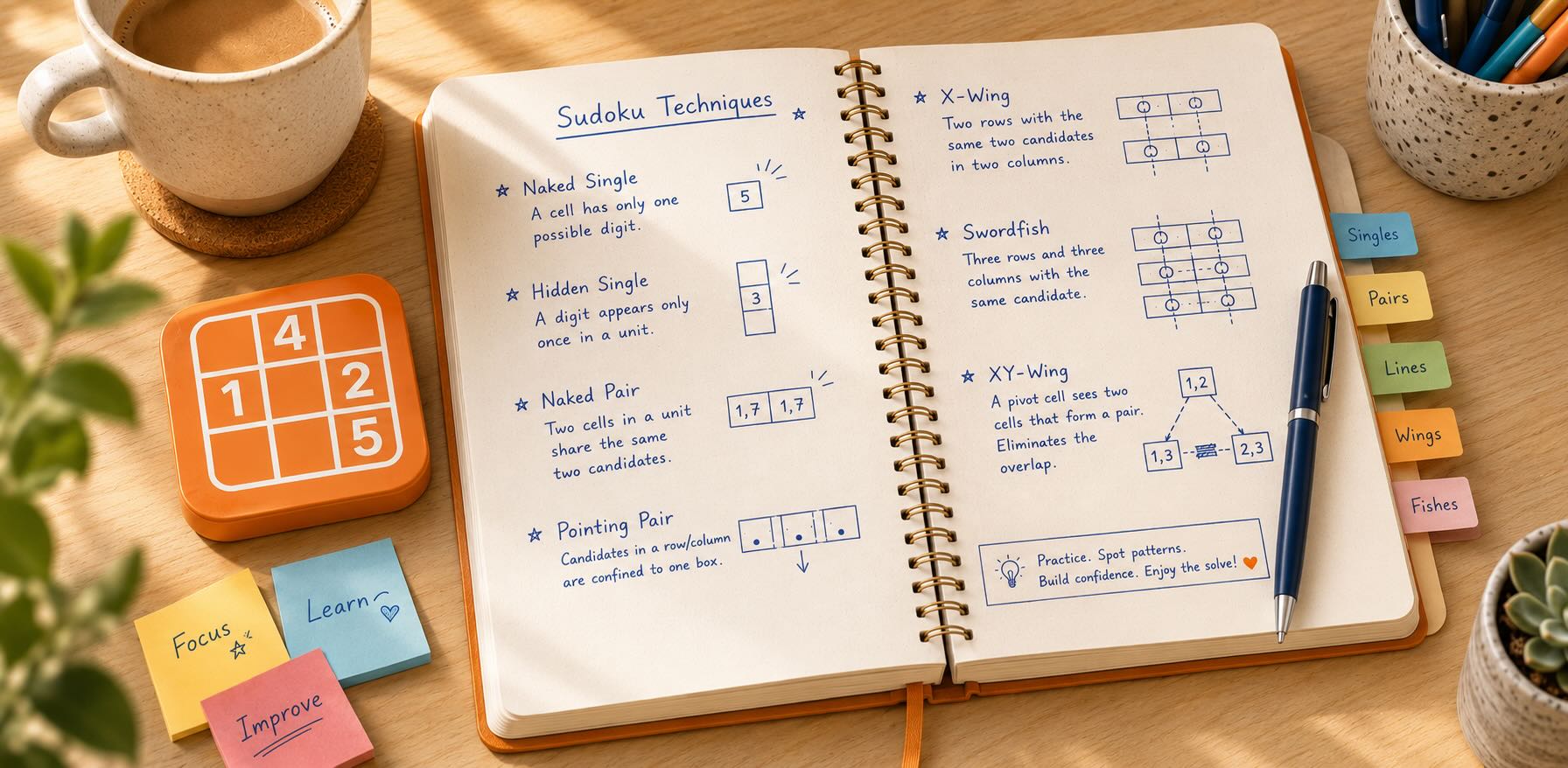
Sudoku is not about guessing — it’s about logic.
This guide brings together practical Sudoku tips and strategies used in MarApp Sudoku, from basic scanning to advanced solving methods. Each technique is explained clearly and illustrated, so you can learn to solve even the hardest puzzles step by step.
Introduction
Sudoku is often described as a number puzzle, but the real skill in Sudoku is not arithmetic. It is pattern recognition and logical deduction. Every correct move comes from information that is already visible in the puzzle. The challenge is to learn how to read that information in a structured way.
This guide explains the same solving methods used in MarApp Sudoku. If you are new to Sudoku, start with the basic techniques and practice recognizing them in the MarApp Sudoku Novice level. If you already solve comfortably, the later sections will help you recognize more advanced patterns with greater confidence.
A useful way to think about Sudoku is this: every empty cell belongs to three groups (units) at the same time.
- It belongs to a row
- It belongs to a column
- It belongs to a 3×3 box
The correct digit for that cell must fit all three groups without repeating a number that is already present. Every solving method in this guide grows out of that basic rule.
Quick Sudoku tips before you start
Before learning specific techniques, a few habits make almost every Sudoku puzzle easier to approach:
- Scan rows, columns, and 3×3 boxes for obvious forced numbers before adding many notes.
- Use notes to track candidates, and keep them updated as the board changes.
- Start with simple techniques, then use more advanced techniques when the easy moves are no longer visible.
- After eliminating candidates with an advanced technique, return to the basics. The next move may now be a simple single or an obvious placement.
Novice Techniques
The beginner techniques form the foundation of all good Sudoku solving. They are the first patterns most players learn, and they remain important even in harder puzzles. Many advanced puzzles still contain moments where a simple observation opens the way forward.
For that reason, strong Sudoku players do not leave these methods behind. They keep returning to them throughout the solve, using them whenever the opportunity appears.
Naked Single
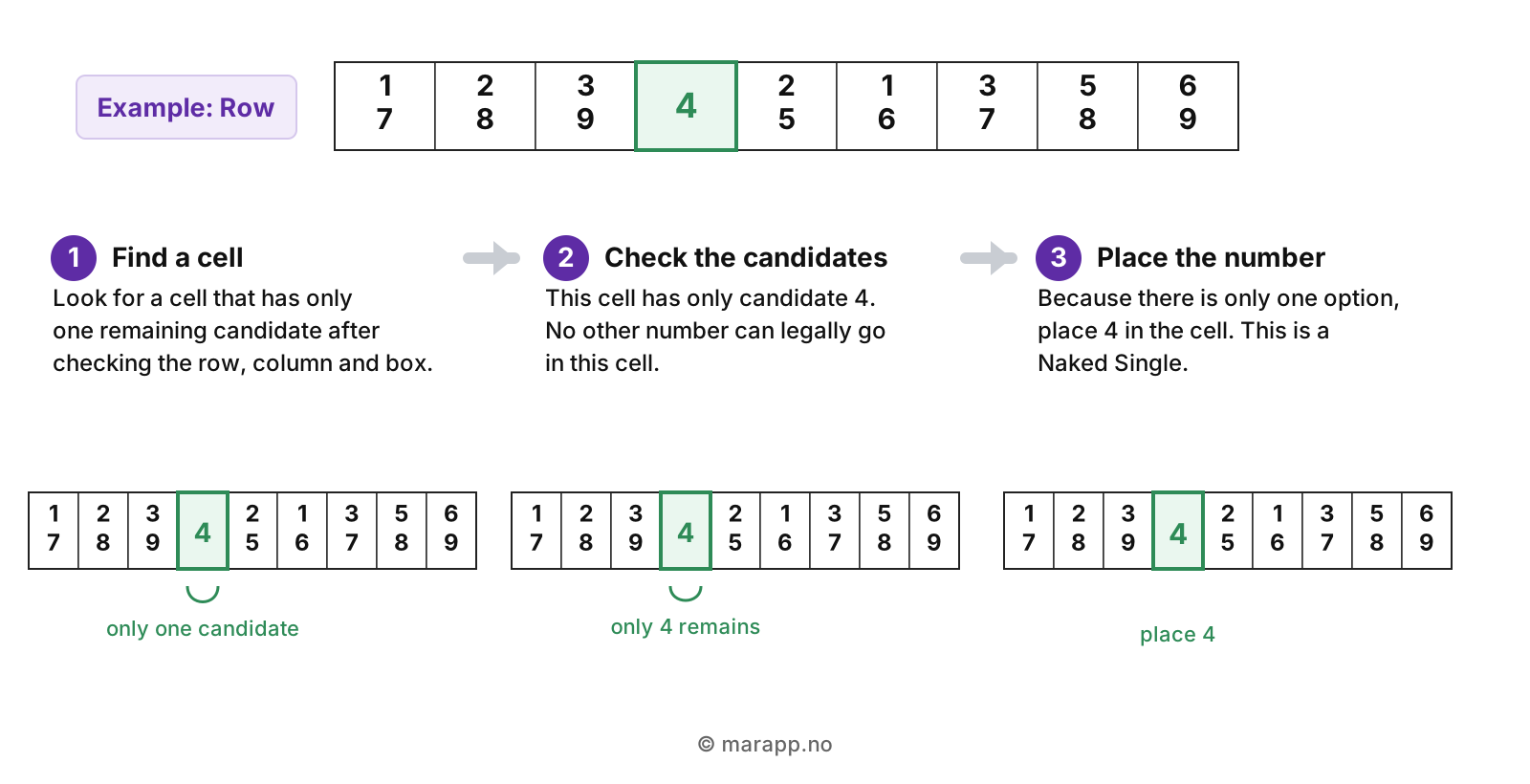
A Naked Single is the most direct type of deduction in Sudoku. It appears when one empty cell has only one possible value left. In other words, every other digit from 1 to 9 is ruled out by the numbers already present in the same row, column, or box.
This is often the first method a new player notices naturally. You look at an empty cell, compare it with its surroundings, and realize that only one number can fit there. Once that happens, the move is certain.
How to spot it
Choose an empty cell and check the digits already used in its row, column, and box.
- Eliminate those digits from consideration
- If only one candidate remains, that candidate is the solution
It will help to see this more clearly if you turn on highlight for selected rows & columns and sub-grid in the MarApp Sudoku settings
Why it works
Each cell must contain exactly one digit. If eight of the nine digits are impossible, the remaining digit is forced.
What to learn from it
The main lesson of the Naked Single is careful elimination. By training yourself to compare one cell against all three of its groups, you begin to build the observation skills needed for every later technique.
Hidden Single
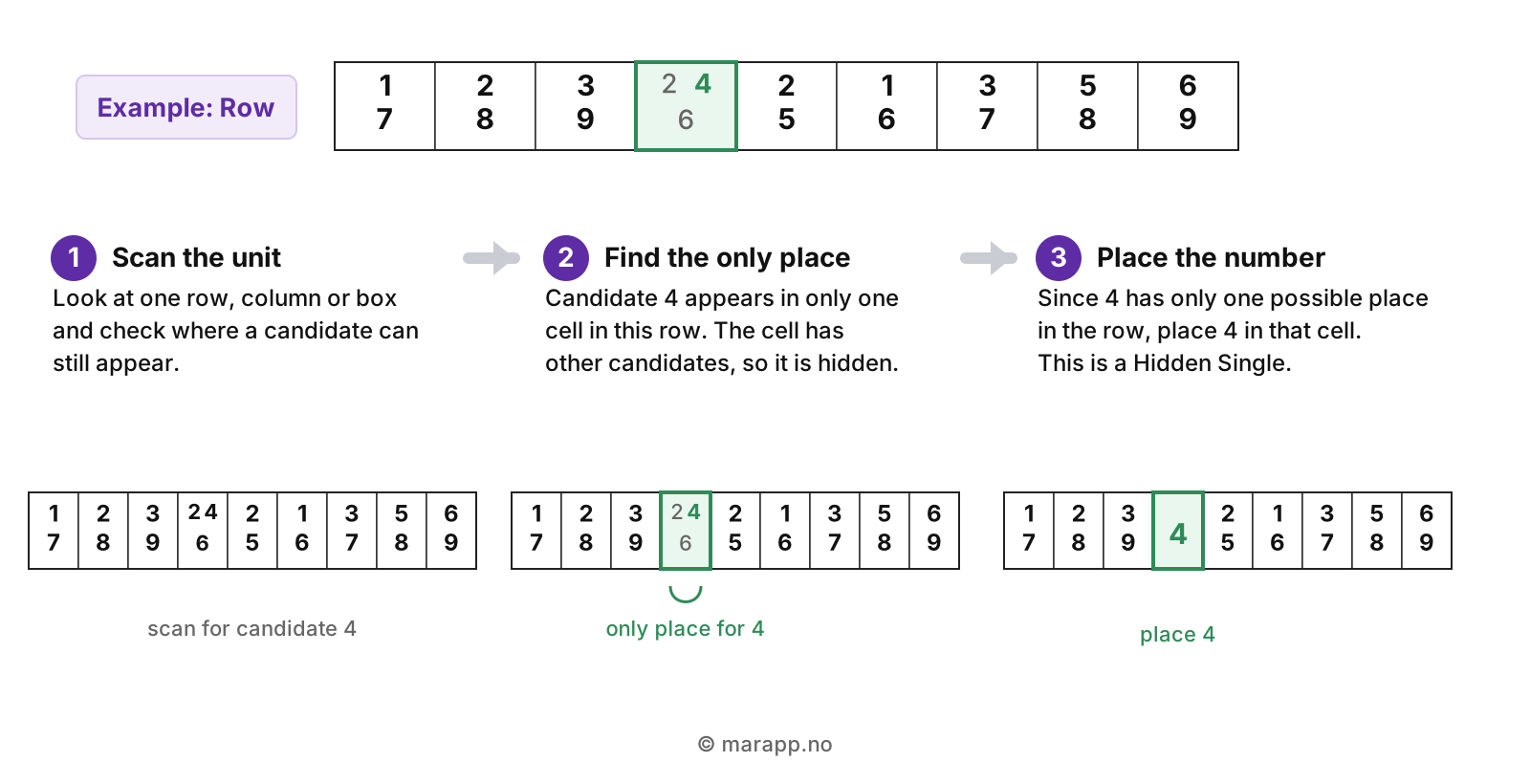
A Hidden Single is slightly less obvious than a Naked Single. Here, the important question is not “What can go in this cell?” but “Where can this digit go in this row, column, or box?”
A digit may be possible in only one place within a unit, even if that cell still contains several candidates. The correct number is therefore hidden among other possibilities.
How to spot it
Pick a row, column, or box and focus on one digit.
- Check all empty cells in that unit
- Identify where the digit can and cannot go
- If only one cell can contain the digit, that is the solution
Why it works
Each digit from 1 to 9 must appear exactly once in every row, column, and box. If only one location remains available, the puzzle forces the digit into that position.
What to learn from it
This method teaches you to shift perspective. Instead of focusing only on cells, you begin to track individual digits across an entire unit.
Advanced Techniques
Once Singles become harder to find, the next step is to look for relationships between candidates. Advanced techniques are often about removing possibilities rather than placing numbers directly.
These eliminations simplify the puzzle and often create new opportunities to use simpler methods again.
Naked Pair
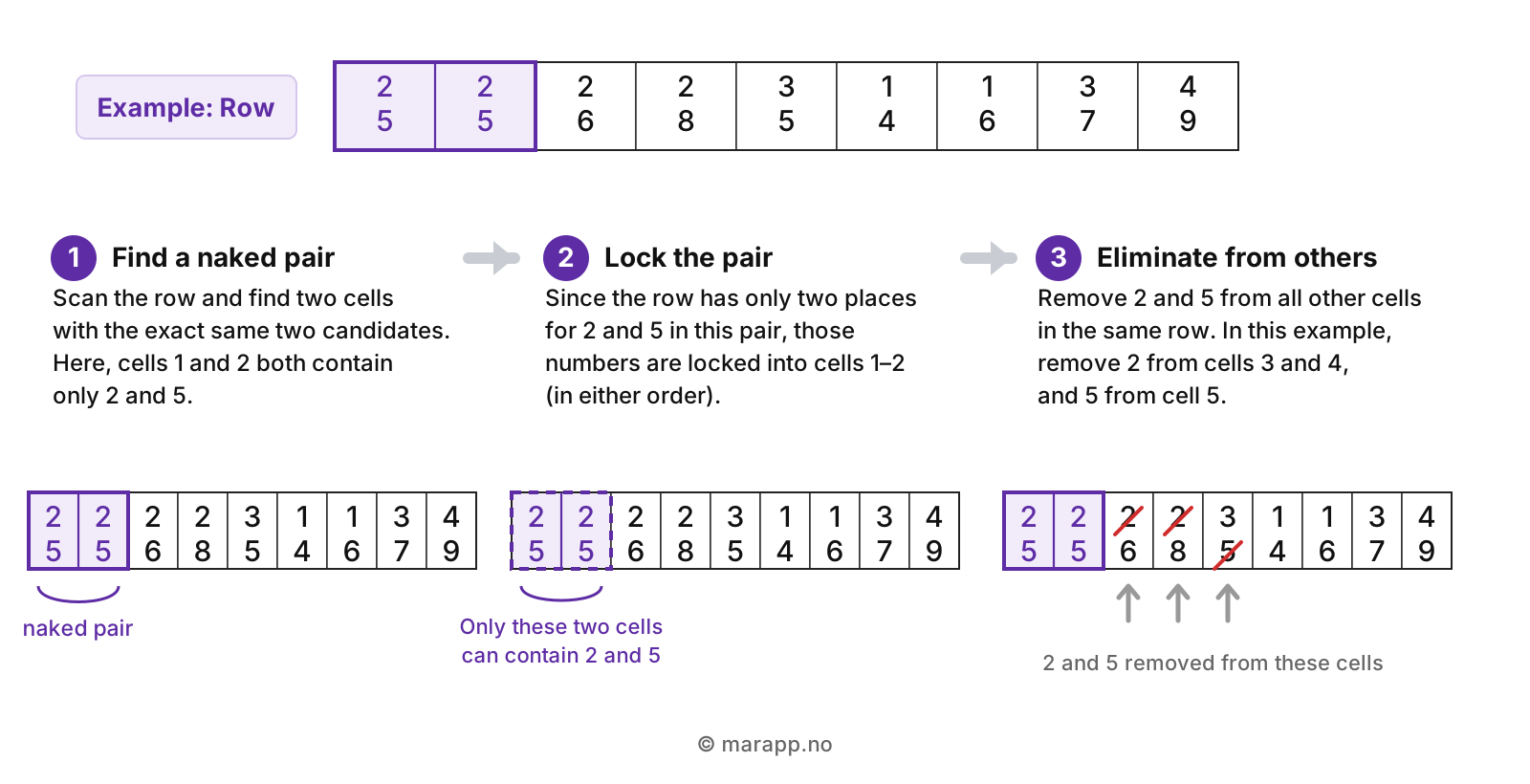
A Naked Pair appears when two cells in the same row, column, or box contain exactly the same two candidates, and no others.
Even though you may not know which number goes in which cell, you know that those two numbers must occupy those two cells. That knowledge allows you to remove those candidates from other cells in the same unit.
How to spot it
Scan a unit for two cells that share exactly the same two candidates.
- Confirm that both cells contain only those two candidates
- Remove those candidates from all other cells in the unit
Why it works
The two numbers are locked into those two cells. Since they must appear there, they cannot appear anywhere else in the same unit.
What to learn from it
This technique shows that even incomplete information can be useful. You do not need to place a number to make progress; eliminating wrong options is just as powerful.
Hidden Pair
A Hidden Pair works in the opposite way. Instead of looking for cells with only two candidates, you look for two digits that can only appear in the same two cells within a unit.
Those cells may currently contain extra candidates, but the key is that the two important digits are restricted to them.
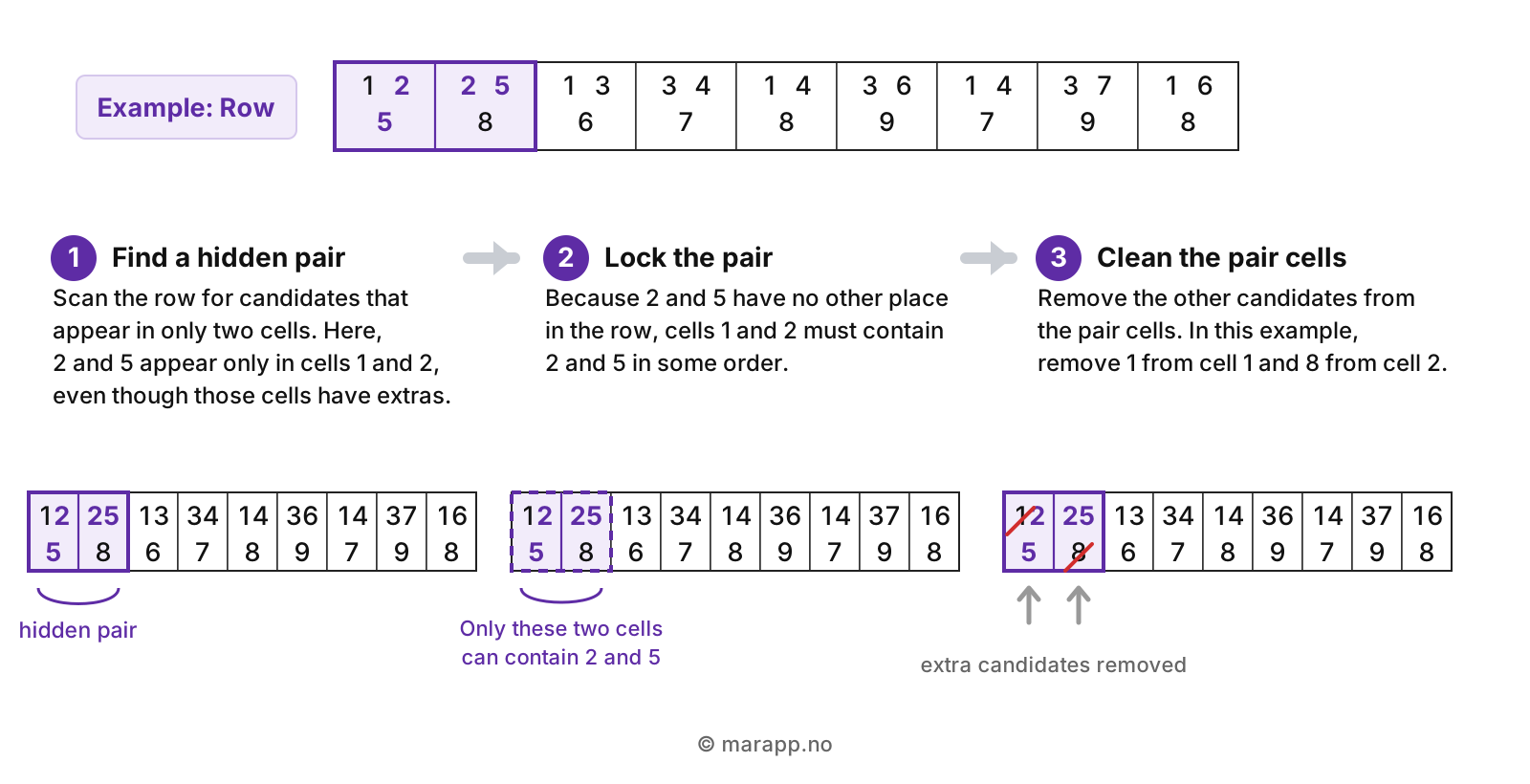
How to spot it
Choose a unit and focus on candidate distribution.
- Identify two digits that appear only in the same two cells of that unit
- Remove all other candidates from those two cells
Why it works
If the unit must contain both digits, and only two positions are available, those positions are reserved. Any other candidates in those cells must therefore be incorrect.
What to learn from it
This technique trains you to track specific digits rather than just scanning for small candidate lists.
Pairs are often the first candidate groups you learn to recognize. The same logic can also apply to three cells or three digits, creating triples.
Naked Triple
A Naked Triple appears when three cells in the same row, column, or box contain only three candidates between them.
The three cells do not all need to contain the exact same candidates. For example, the cells might contain 1/3, 1/4, and 3/4. Since those three numbers must occupy those three cells in some order, they can be removed from all other cells in the same unit.
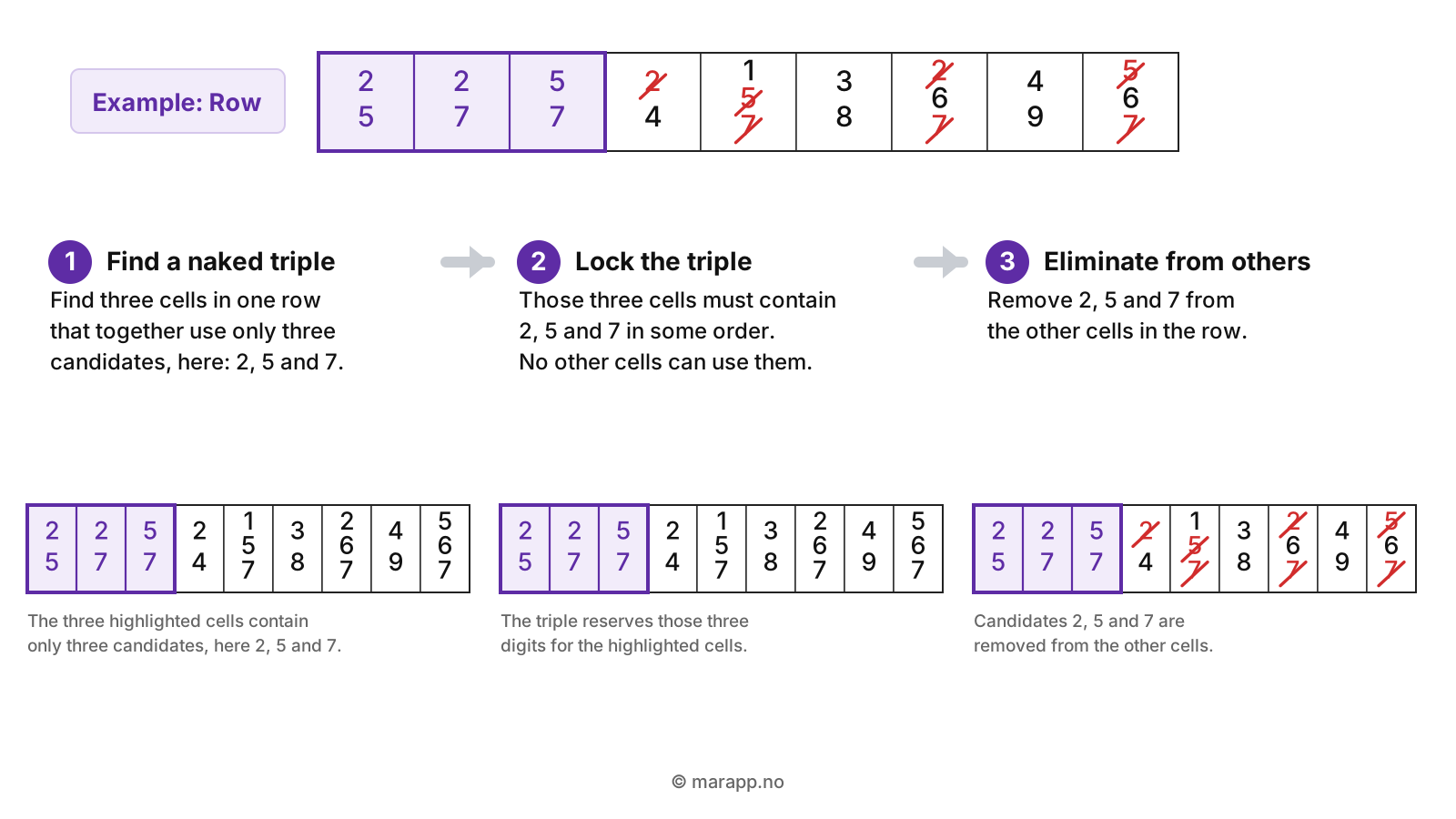
How to spot it
To spot a Naked Triple, scan a row, column, or box for three cells that together contain only three possible digits. First, confirm that the three cells are in the same unit. Then check that their combined candidates are limited to three digits. If they are, remove those three digits from all other cells in that unit.
Why it works
This works because the three digits are locked into the three selected cells. Since each digit can appear only once in the unit, none of those digits can appear anywhere else in that row, column, or box.
What to learn from it
Naked Triples teach you to look at groups of cells together, not just one cell at a time. This is an important step toward recognizing larger candidate patterns.
Hidden Triple
A Hidden Triple works in the opposite way compared to a Naked Triple. Instead of looking for three cells with only three candidates, you look for three digits that can only appear in the same three cells within a row, column, or box.
Those three cells may contain extra candidates, which can make the pattern harder to see. Once the Hidden Triple is found, the extra candidates can be removed from those three cells.
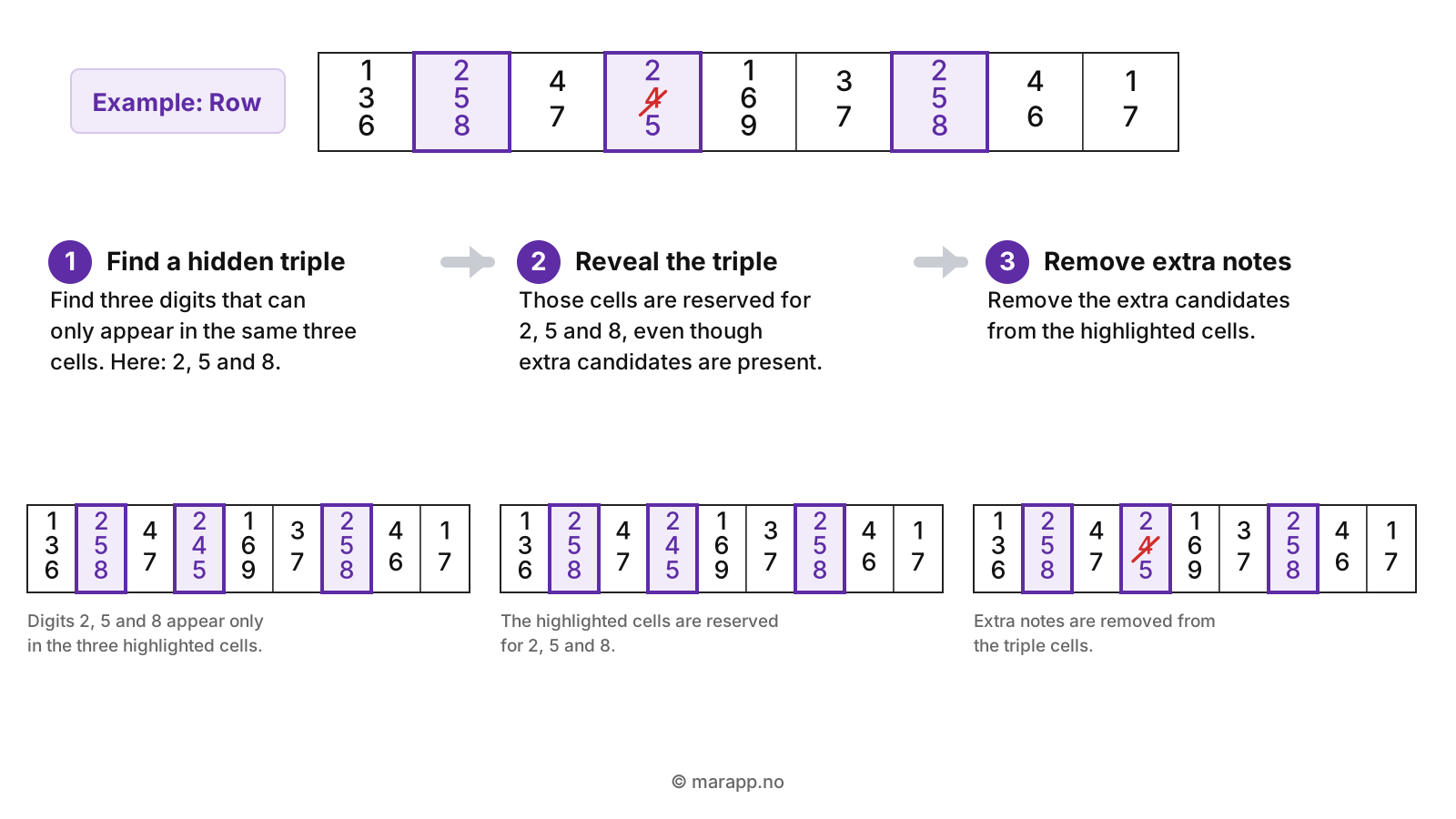
How to spot it
To spot a Hidden Triple, choose a row, column, or box and focus on where individual digits can appear. Look for three digits that are limited to the same three cells. Ignore any extra candidates in those cells at first. Once the triple is confirmed, remove all other candidates from those three cells.
Why it works
This works because the unit must contain all three digits, and those digits have only three possible positions. That means the three cells are reserved for those digits, so any other candidates in those cells must be incorrect.
What to learn from it
Hidden Triples train you to follow candidate distribution across a unit. The important pattern may not be obvious from the number of candidates in each cell, so this technique helps you look beyond the surface.
Pointing Pair and Pointing Triple (Box-Line Reduction)
This technique appears inside a 3×3 box when all possible positions for a digit lie in a single row or column.
When that happens, the digit must be placed somewhere along that line within the box. This allows you to eliminate that digit from the rest of the row or column outside the box.
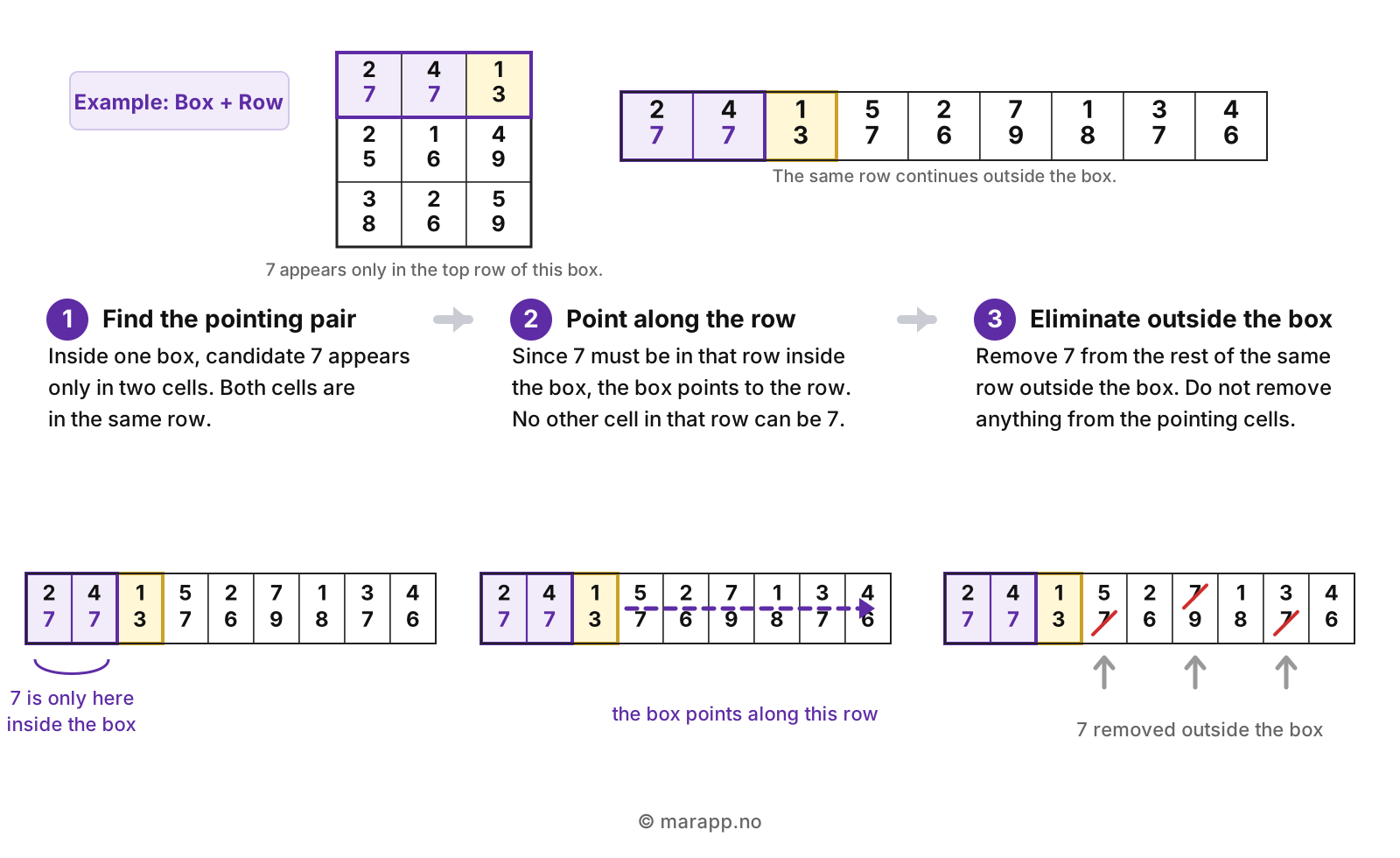
The example above shows a Pointing Pair, where the candidate is limited to two cells in the same row or column within a box. In a Pointing Triple the logic is similar, but the candidate is limited to all three cells in the same row or column within a box.
How to spot it
Look inside a box and focus on one digit.
- Check if all candidates for that digit are aligned in one row or column
- If so, remove that digit from the rest of that row or column outside the box
Why it works
The box forces the digit into a specific line. Since the digit must appear there, it cannot appear elsewhere along the same line.
What to learn from it
This method shows how different parts of the grid interact. A restriction in one area can create immediate consequences elsewhere.
Expert Techniques
Expert techniques involve larger patterns and require more deliberate scanning. They may look complex at first, but they are built on the same logical principles as simpler methods.
The key is to stay patient and focus on understanding the structure behind each pattern.
X-Wing
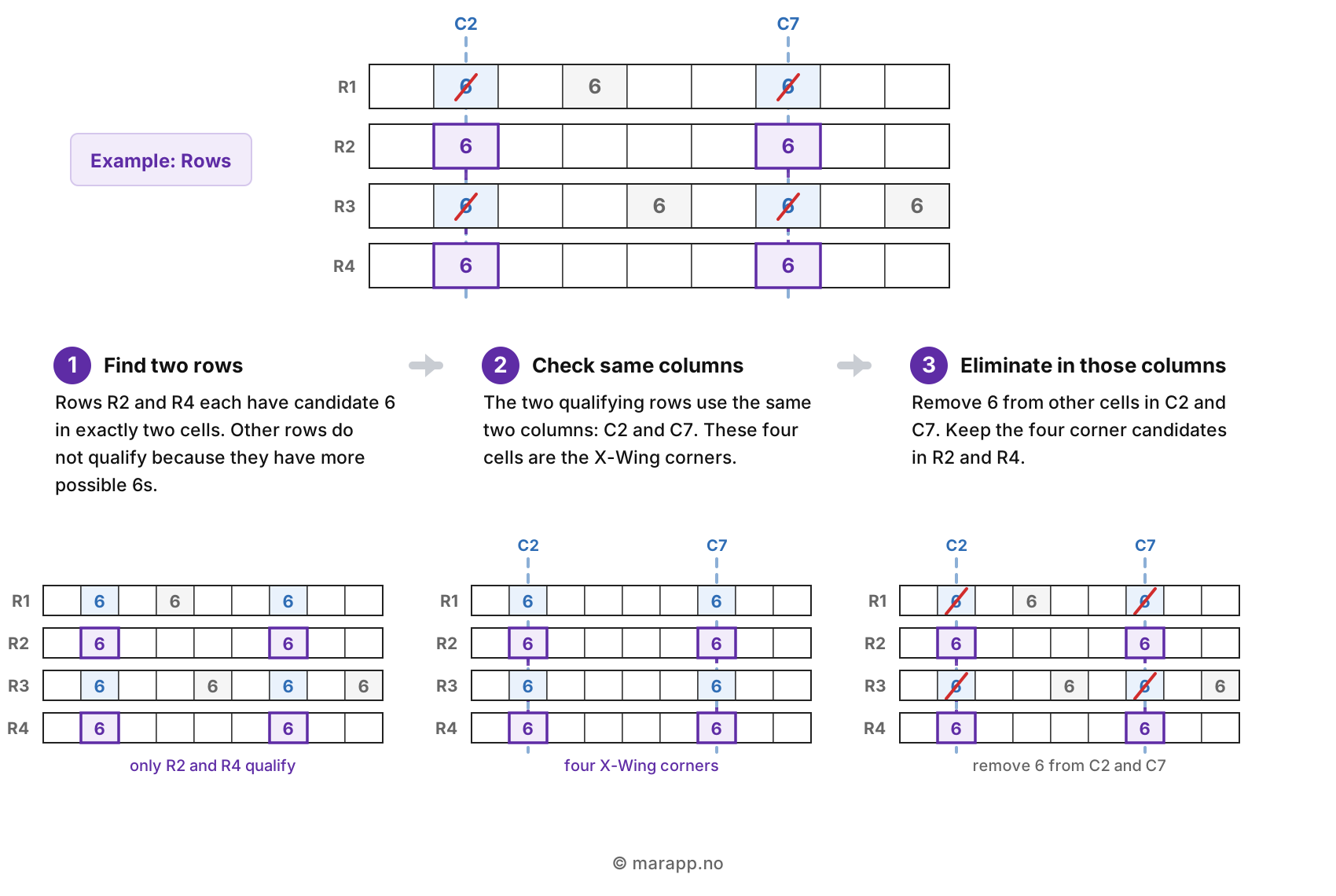
An X-Wing involves two rows and two columns. It appears when a digit is limited to the same two positions in two different rows, forming a rectangle.
How to spot it
Choose a digit and scan across rows.
- Find two rows where the digit appears in exactly the same two columns
- Confirm that these positions form a rectangle
- Eliminate the digit from other cells in those columns
Why it works
The digit must appear once in each row, and the only available positions are aligned. This locks the digit into the rectangle and excludes it from other cells in those columns.
What to learn from it
This technique encourages you to look for patterns across the entire grid rather than focusing on one small area.
Swordfish
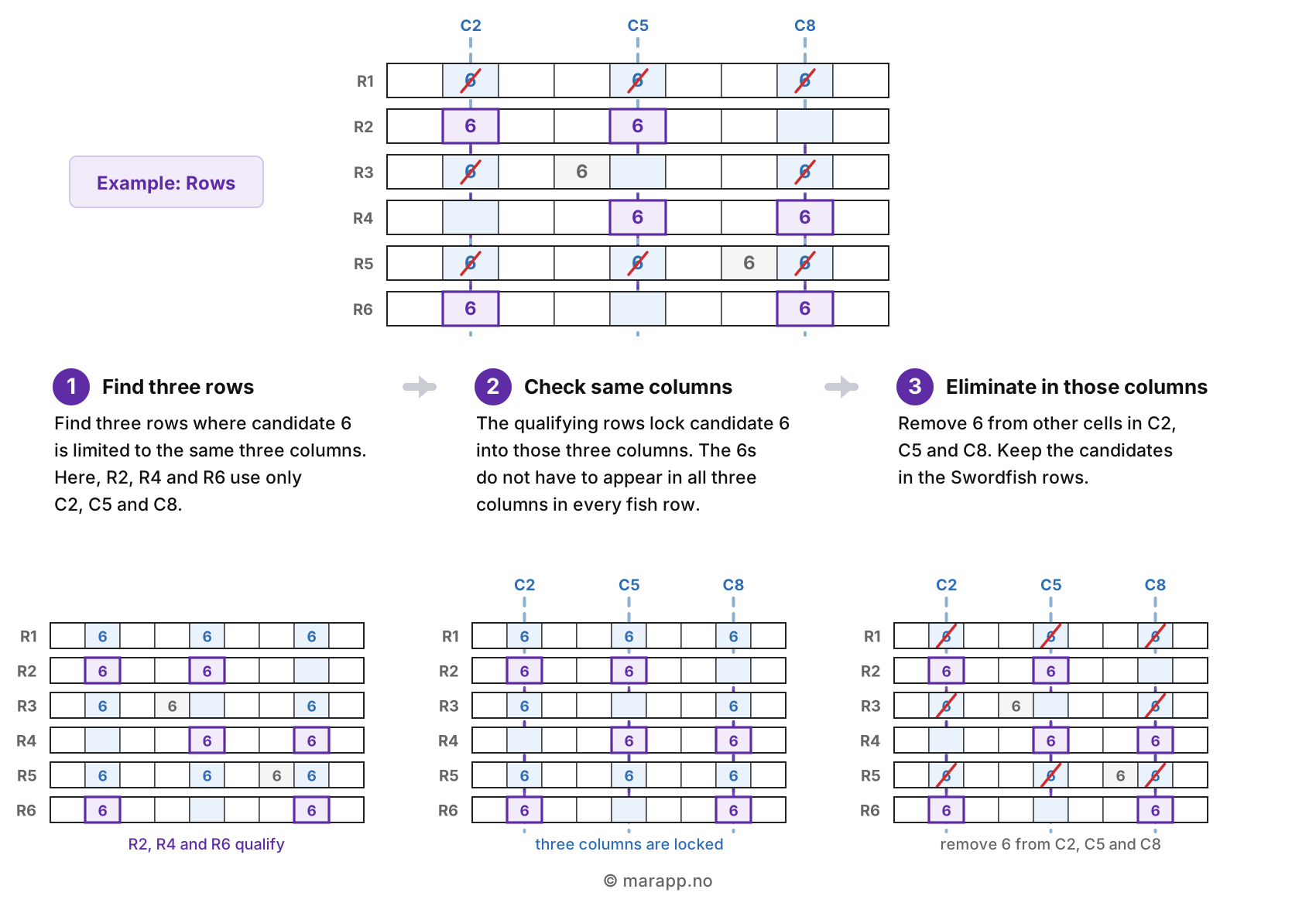
Swordfish is a larger version of the X-Wing pattern, involving three rows and three columns.
It occurs when a digit is confined to the same three columns across three different rows.
How to spot it
Choose a digit and examine multiple rows.
- Look for three rows where the digit appears in only two or three positions
- Check if those positions align within the same three columns
- Eliminate the digit from other cells in those columns
Why it works
The three rows collectively force the digit into those three columns. No additional occurrences of the digit can exist in those columns outside the pattern.
What to learn from it
This technique shows that advanced patterns are extensions of simpler ideas. The logic is the same, but applied on a larger scale.
XY-Wing
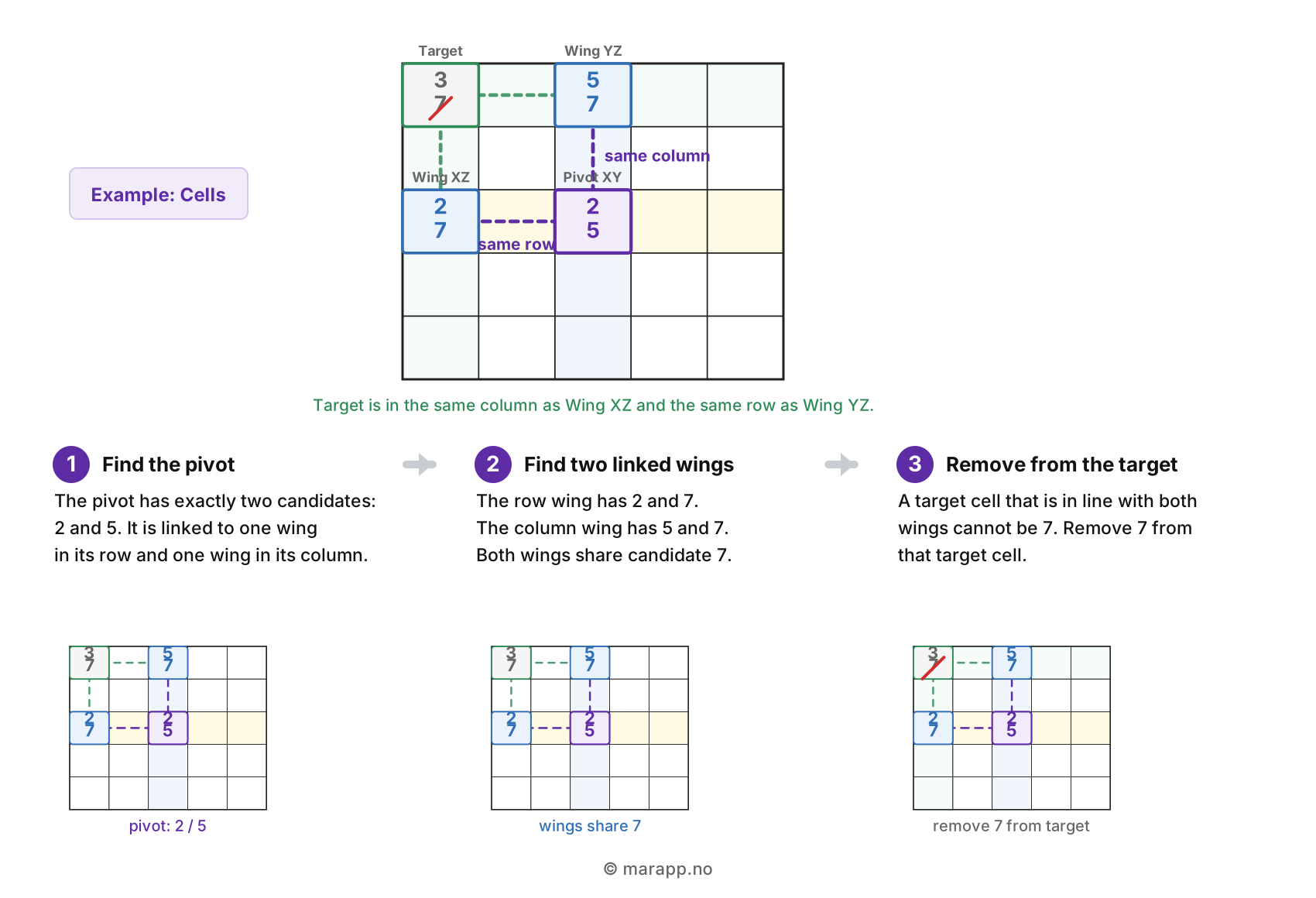
The XY-Wing is a three-cell pattern based on candidate relationships rather than simple alignment.
It involves one pivot cell and two wing cells, each sharing candidates in a specific way.
How to spot it
Look for three cells with the following structure.
- A pivot cell with two candidates (X and Y)
- A wing cell with candidates (X and Z)
- A second wing cell with candidates (Y and Z)
If both wing cells share Z, you can eliminate Z from any cell that sees both wings.
Why it works
Whatever value the pivot takes, one of the wings must contain Z. This guarantees that Z cannot appear in cells that are connected to both wings.
What to learn from it
This technique introduces conditional logic. You learn that even without placing a number, you can still prove that certain candidates are impossible.
How to Practice These Techniques
Learning Sudoku methods is most effective when done step by step.
- Start with Singles until they become easy to recognize
- Practice pairs and candidate elimination techniques
- Move on to larger patterns once you are comfortable
It is also helpful to reflect on each step you take. Ask yourself why a move works, not just what the move is. This builds a deeper understanding of the puzzle.
Keeping your notes clear and consistent is equally important. Many techniques rely on accurate candidate tracking, and messy notes make patterns harder to see. MarApp Sudoku makes this easy for you. Use the Notes tool to place possible candidate notes. While using Advanced or Expert techniques, use the notes tool to eliminate candidates from the notes. When you place a digit in a cell, MarApp Sudoku removes that digit from your notes for the same row, column and sub-grid automagically. If you need an uncluttered look at the gameboard for a moment, use the hide notes tool (Premium feature) in the app bar to toggle notes visibility on or off.
Discover how these techniques work in real puzzles and master them with guided explanations using the “Surrender” feature in MarApp Sudoku with Premium.
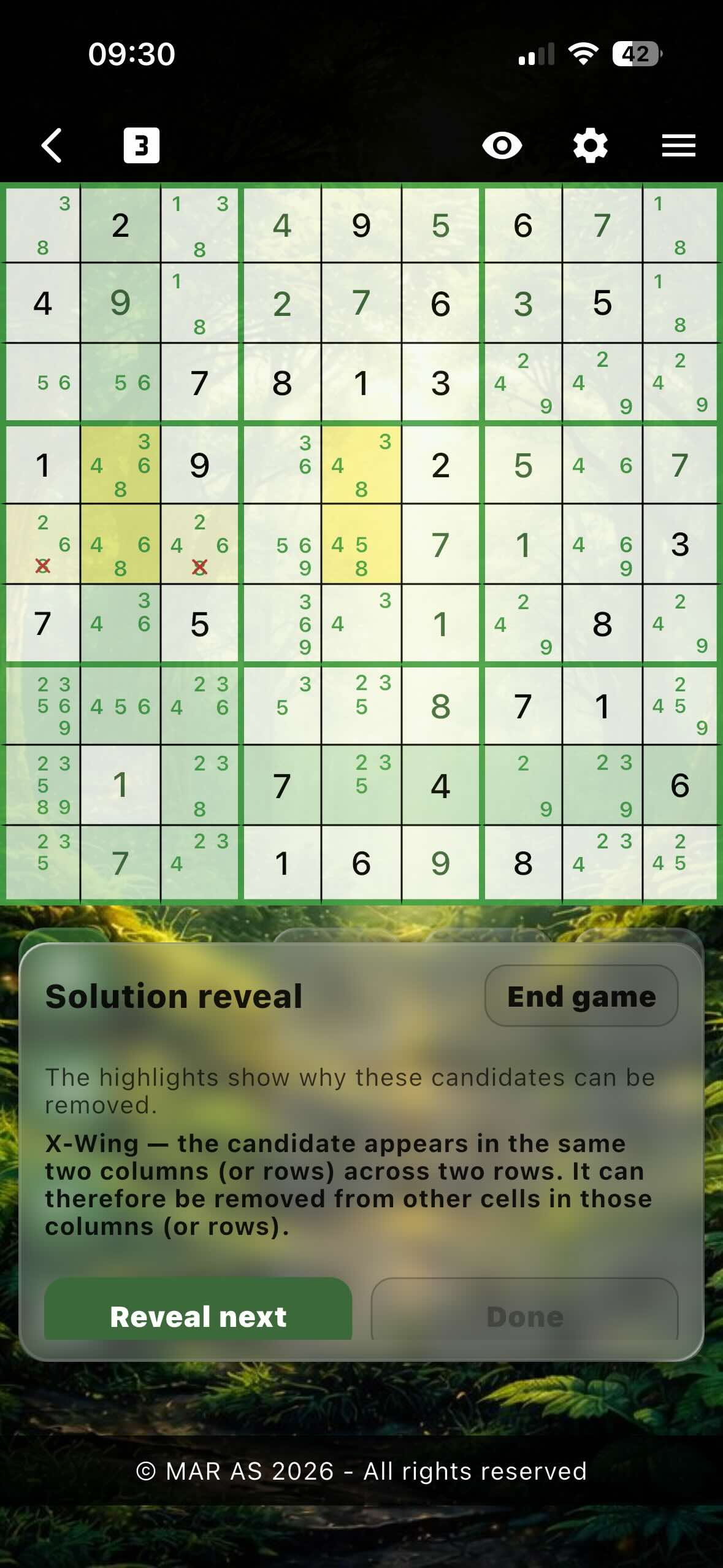
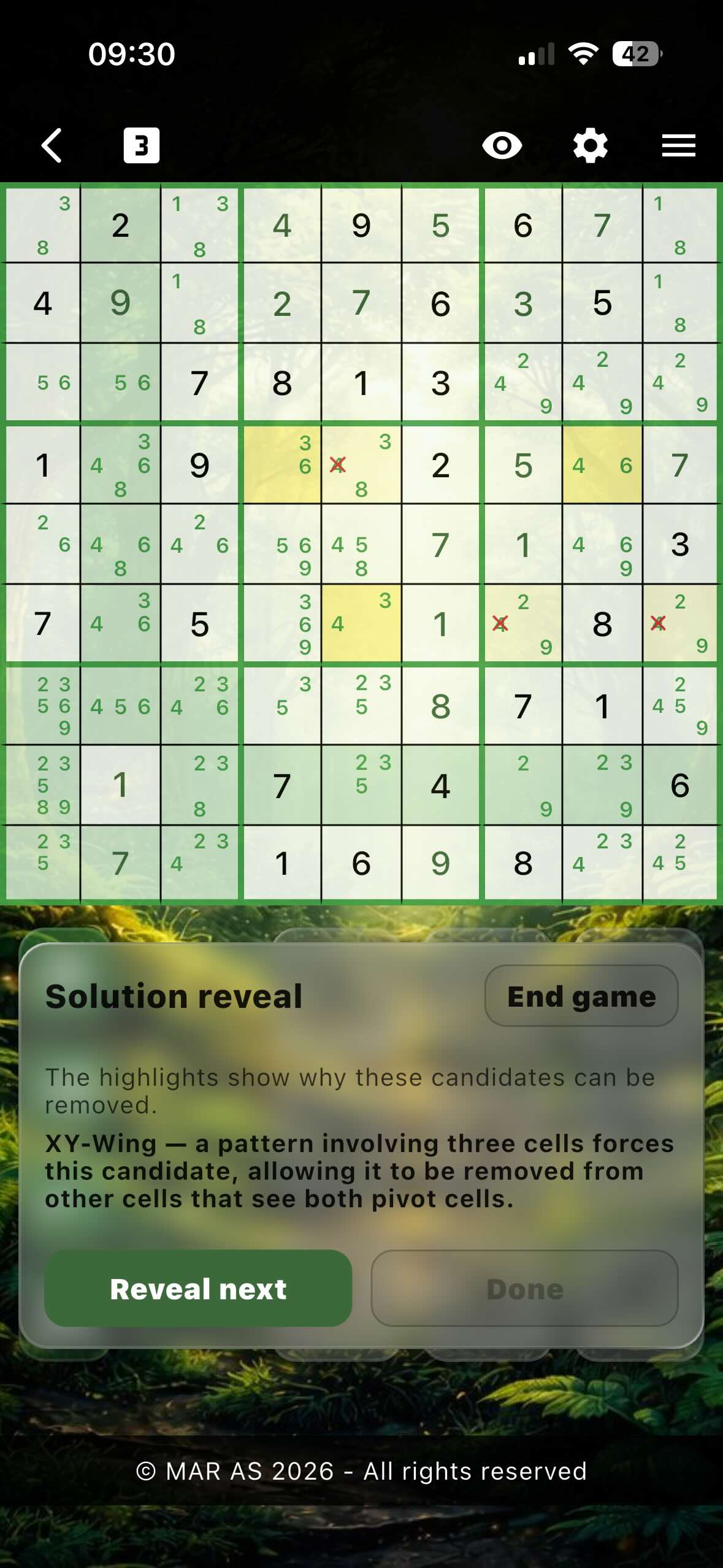
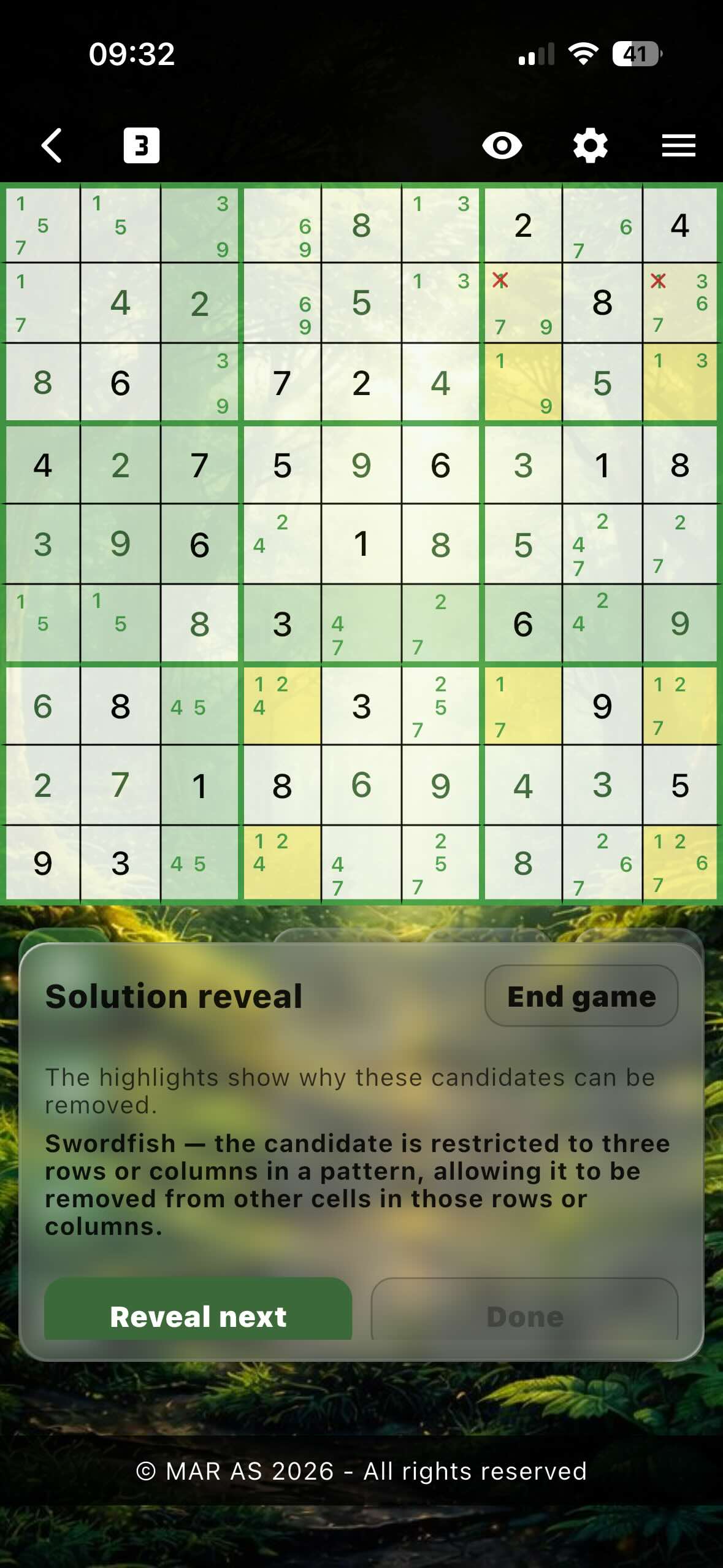
Screenshots from MarApp Sudoku – “Surrender” • 2026 © Mar AS
More advanced Sudoku techniques
The techniques above cover many of the most useful Sudoku solving methods, from basic singles to more advanced patterns such as X-Wing, Swordfish and XY-Wing. As puzzles become harder, there are also several more advanced techniques that can help you make progress when the usual methods are not enough.
Examples include Skyscraper, Two-String Kite, Finned X-Wing, Jellyfish and XY-Chains. These techniques build on the same core ideas: looking at where candidates can go, finding patterns across rows, columns and boxes, and using those patterns to safely remove impossible candidates.
You do not need to learn every advanced technique to enjoy Sudoku. Start with the basics, practice one technique at a time, and gradually add more strategies as the puzzles become more challenging.
Final Thoughts
Sudoku is not about speed or guessing. It is about understanding structure and applying logic with confidence.
The techniques in this guide are all connected. Each one builds on the same core idea: every digit must fit perfectly within its row, column, and box.
As you practice, these patterns will become easier to recognize. Over time, puzzles that once felt difficult will begin to feel structured and approachable.
MarApp Sudoku is built around this way of solving. By learning these techniques, you are learning the same logic the app uses to analyze puzzles and explain each step.